
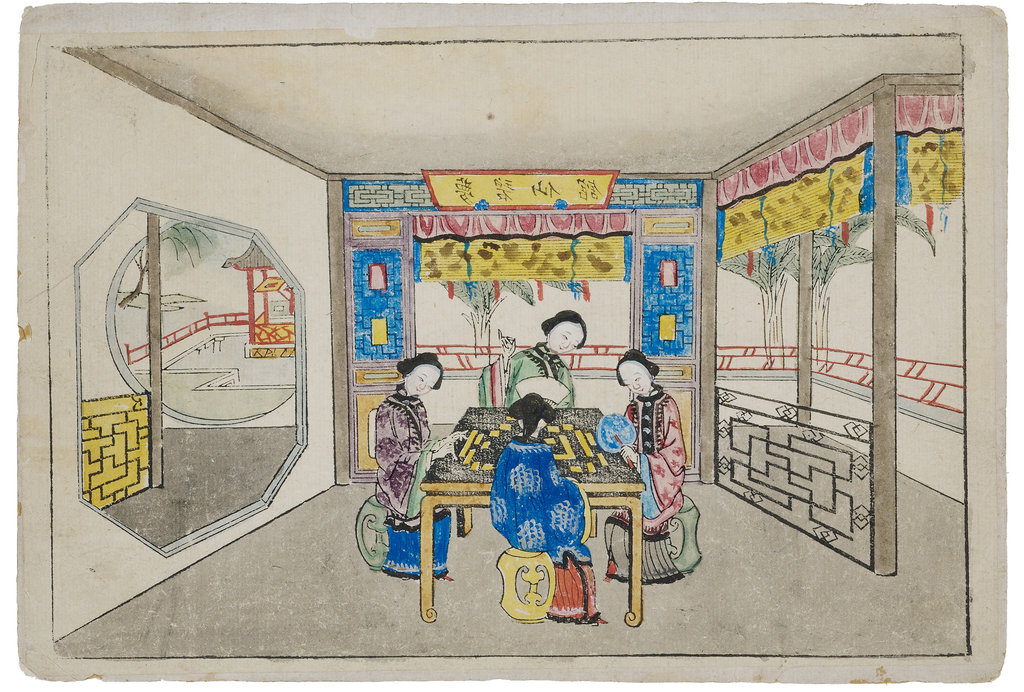
Mahjong — 麻將 (májiàng) — is a Chinese game, and every set on every table anywhere in the world traces back to that origin. It is worth saying plainly, because the game travelled so widely in the twentieth century that its roots are sometimes treated as a footnote. They are not a footnote. The tiles, their suits, their names and the rhythm of the game all come from Chinese culture, and the versions played today are branches of that tree rather than replacements for it.
Origins in nineteenth-century China
The game as we recognise it took shape in the mid-to-late 1800s, most commonly associated with the Jiangsu, Zhejiang and Shanghai regions around the Yangtze River delta. Its immediate ancestors were Chinese card games played with slender paper money cards — games built on suits, sequences and sets. Moving that structure onto tiles of bone and bamboo made the game durable, tactile and loud in the best way, and it spread quickly through teahouses and homes. Popular accounts attach the invention to a single named person; historians are more cautious, and the honest answer is that mahjong emerged from a living tradition of games rather than from one inventor.
What the tiles carry
The three suits are drawn directly from that money-card lineage. Dots (筒, tóng) represent coins. Bams (索, suǒ) represent strings of coins. Cracks (萬, wàn) represent ten-thousands. The honour tiles add the four winds — East, South, West, North — and the dragons: red (中, zhōng, "centre"), green (發, fā, "prosperity") and white (白, bái, the blank). Flower and season tiles bring in plum, orchid, chrysanthemum and bamboo, imagery long associated with the four seasons and with scholarly painting. Even the name is descriptive: 麻雀 (máquè), sparrow, is said to echo the clattering shuffle of the tiles, and remains the common name for the game in Cantonese-speaking regions.
Many games, one family
There is no single mahjong. Chinese Classical, Hong Kong (Cantonese), Sichuan bloody rules, Taiwanese sixteen-tile, Japanese riichi, Korean, Singaporean and Filipino variants each have their own scoring, their own etiquette and their own devoted players. Riichi, for instance, developed a scoring system and a set of conventions so distinct that it supports professional play. The differences are real, but the family resemblance is unmistakable: four players, a wall, a draw and a discard, and a hand completed with sets and a pair.
How the game reached the West
Mahjong arrived in the United States in the early 1920s and became a genuine craze, sold with an orientalist packaging that often flattened or fictionalised the game's Chinese context. That marketing was of its era and does not deserve repeating. What endured was the game itself. In 1937 a group of players formed what became the National Mah Jongg League and published an annual card of standardised hands — a uniquely American layer added on top of a Chinese game. American mahjong uses jokers, a Charleston exchange of tiles, and hands that change every year with the new card.
The game also became central to Chinese American and Jewish American community life, and in Chinese communities worldwide it has never stopped being a fixture of new year gatherings, family visits and long afternoons. Mahjong parlours in Hong Kong, Taipei and across the mainland remain living institutions, and mahjong is recognised in China as part of its cultural heritage.
Playing with respect
We design tile sets and mats for the American game, and we think the best way to honour where it comes from is simple: know the source, use the real names, and say so. Learn what the suits mean. Try a Hong Kong or riichi hand if you get the chance — the game opens up when you see how many ways there are to play it. And if you are teaching someone their first Charleston, tell them where the tiles in their hand came from. The history is part of the pleasure.
New to the table? Start with mahjong terms explained or our step-by-step guide to American mahjong. Tile sets and mats are in the shop.