
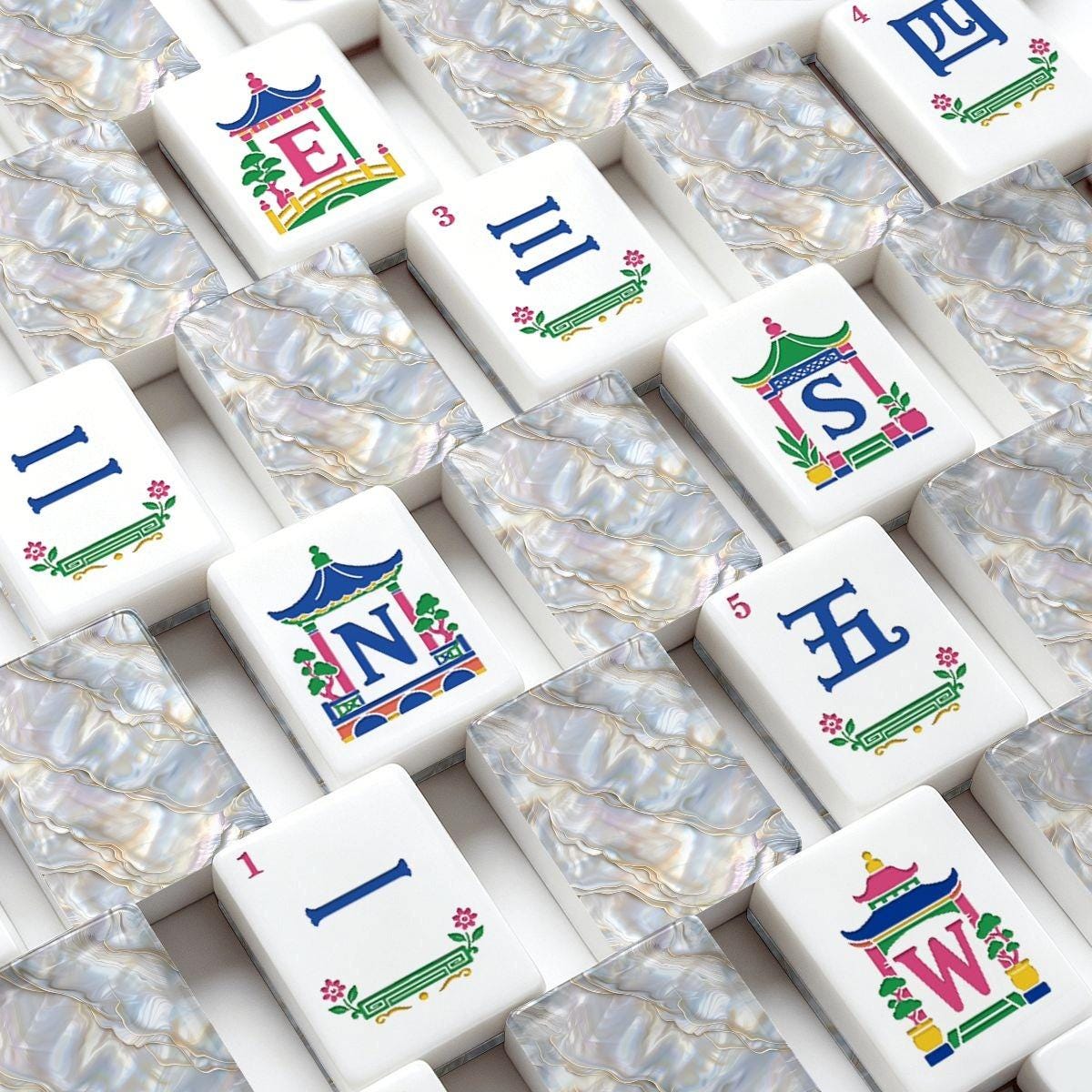
What's in an American set
Three suits — dots, bams and cracks — numbered one through nine, with four of each tile. Add winds, dragons, flowers, jokers and a few blanks, plus dice. You play from a card of legal hands rather than memorizing patterns, so a beginner and a veteran start each hand on genuinely similar footing.
Setting up
- Turn every tile face down and mix them thoroughly with both hands.
- Each player builds a wall two tiles high in front of them; push the four walls together into a square.
- Deal around the table until each player holds thirteen tiles. The dealer takes one extra to start.
- Stand your tiles on a rack so only you can see them, and open the current year's card.
The Charleston
Before play begins, players pass three unwanted tiles at a time in a set sequence — right, across, left, then back again. Jokers never travel in the Charleston. Pass away what doesn't serve the hand you're aiming for, and watch what arrives: the tiles other players give up are the clearest early read you'll get on the table.
The flow of a turn
- Draw one tile from the wall.
- Decide whether it moves you toward the hand you chose on the card.
- Discard one tile face up and say its name aloud.
- Play passes to your right. Anyone may call that discard if it completes a group of three or more.
Words you'll hear
- Charleston
- The opening rounds of passing three unwanted tiles between players.
- Card
- The annually published sheet of legal hands everyone plays from.
- Exposure
- A called group laid face up on your rack for the table to see.
- Joker
- A wild tile usable in groups of three or more — never in a pair or a single.
- Wall
- The stacked rows of face-down tiles players draw from.
- Mahjong
- Declared when your fourteen tiles match a hand on the card exactly.
Want the longer version, with video? Read the full guide to playing American mahjong, or pick up free printables on the freebies page.